How can beginners master Inline Skates? A breakdown of techniques from scratch.
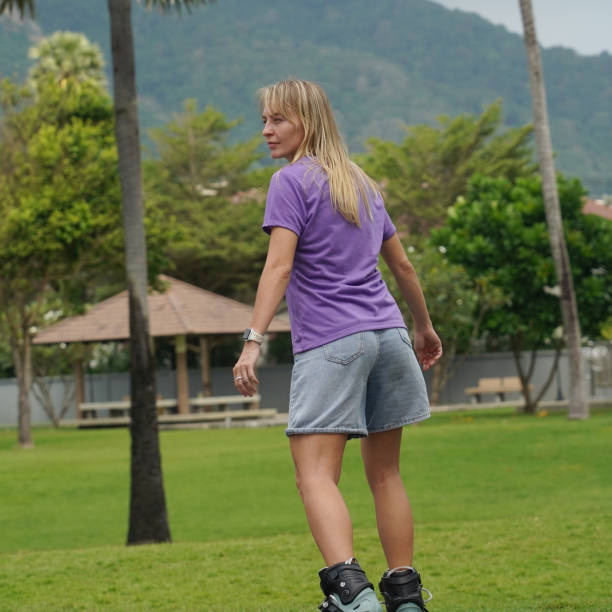
Inline skating backwards is a psychological hurdle that almost all beginners encounter.
Many people are already very stable when skating forwards, but they instantly become nervous when they try to skate backwards for the first time: they dare not move, dare not back up, and even lose their balance as soon as they put their feet back.
strength butThe truth is, inline skating isn’t a particularly difficult skill. It doesn’t really test strength but rather an understanding of weight distribution, rhythm, and wheel feedback. With the correct breakdown, even starting from scratch, you can learn it step by step.
This article will focus on how beginners can safely and steadily master Inline Skates, breaking down the entire learning process from the principles of the movement and practice steps to common mistakes.
skills Table of Contents
1. Why is inline skating so scary for beginners?
Of all the inline skates, the backward skating isn’t the most complicated, but it is certainly the most nerve-wracking.
1. My sense of direction has been “reversed.”
When skating forward, your body, vision, and skating direction are aligned.
When skating backward, your body moves backward, but your eyes remain forward; this inconsistency causes the brain to temporarily “shut down.”
cowardly but This isn’t because you’re cowardly but rather a basic human instinct.
2. Fear of losing control
Many beginners repeatedly ask the same question:
“What if I lose control while skiing backwards?”
time.” This actually illustrates a problem:
you haven’t yet established the sense of security that “I can stop at any time.”
3. Lack of clear awareness of center of gravity
Inline Skates requires a higher level of balance.
Standing too upright will cause you to fall;
leaning back is even more dangerous.
Therefore, the reason why backslides seem difficult is simply because
your basic control is not refined enough, not because you are not suited for it.

II. Three essential abilities you must possess before you begin sliding backwards.
Before practicing backwards, make sure you have the following qualifications.
If not, focus on building a solid foundation; it’s much more effective than cramming.
1. Stable braking capability under forward slip conditions
Whether you use a Heel Brake or a T-stop, as long as you can stop within a controllable distance, that’s enough.
Skidding backwards doesn’t mean “can’t brake,” but rather “brakes in a different direction.”
2. Low center of gravity gliding habit
If you often stand very straight when skating forward, it will be very difficult to skate backward.
Inline Skates = Low center of gravity + bent knees
This is a hard requirement.
3. Has a basic feel for the edges of the wheels.
flat but Backward sliding is not about pushing backward with the wheels flat but about using fine adjustments to the inner and outer edges of the wheels to propel yourself forward.
If you can’t feel any change in the force on the wheels, don’t rush to slide backwards.
III. Starting from Scratch: Inline Skates Reverse Sliding Decomposition Tutorial
Step 1: Without sliding, only establish a backward-sliding “standing posture.”
This is crucial, yet it’s also the easiest thing to overlook.
Standard backward sliding stance:
- Feet slightly wider than shoulder-width apart
- Toes slightly turned inward (not outward)
- Knees are noticeably bent
- Lean forward slightly
- Look straight ahead or to the side.
The purpose of this posture is singular:
to keep the center of gravity firmly positioned directly above the wheel.
You can repeatedly check against a wall or railing; there’s no need to slide.
Step 2: Feel the force exerted while sliding backward in place (do not aim to slide backward).
Next, don’t rush to reverse the distance.
Practice method:
- Maintain the backward sliding stance
- Slightly push your left foot outward in an arc
- Keep your right foot stable
- Feel the force on the edge of the wheel
- Alternating left and right
At this stage, you are practicing “feeling,” not distance.
If you can clearly feel the wheels being “pushed” rather than “slipping around,” it means you’re on the right track.
Step 3: Short backward slide (30–50 cm)
This is the first time many people have truly “stepped back.”
The key principles can be summed up in just four words: slow, steady, small.
- The push wheel should have a small amplitude.
- The backward distance should be short.
- Slow down the pace
- Don’t tense up your body
If you can slide backwards for half a meter at a time and then stand still, that’s already very good.
Step 4: Continuous Backflipping and Establishing Rhythm
When you can continuously slide backwards for 2-3 meters, it means you have entered a stable period.
At this stage, the focus is not on speed, but on:
- Is the force exerted by both feet symmetrical?
- Is the reverse sliding direction off?
- Does the body begin to relax naturally?
Reference lines can be set on the ground to help determine the trajectory.

IV. Five common mistakes beginners make when sliding backwards in inline skates
Mistake 1: Leaning back to find balance
This is the most dangerous mistake.
When skating backwards, leaning back is equivalent to actively shifting your center of gravity out of the wheel’s range.
Correct approach: Keep your body pressed forward throughout.
Mistake 2: Excessive outward turning of the toes
Swinging outwards will cause the wheels to lose control, and the harder you try to skate, the more erratic it becomes.
Correct approach: Slightly pull inwards.
Mistake 3: Constantly looking down at your feet
This would directly disrupt the balance system.
Correct approach: Look ahead and use your peripheral vision to sense your footing.
Mistake 4: Applying too much force at once
ground, but Sliding backwards is not about pushing off the ground but about pushing the wheels.
Correct approach: Small movements, multiple times.
Error 5: Unable to safely end the backward skiing
Many people don’t lack the ability to slide backwards; they’re afraid to stop.
Correct procedure:
Practice the complete process of skating backwards → turning forward → braking to a stop.
5. How to practice inline skates more safely?
1. Venue Selection
- Level cement floor or indoor area
- Avoid slopes
- Avoid crowded areas
2. Protective gear must be worn.
- In the initial stages of backward skating, the probability of falling backward is much higher than when skating forward.
- Knee pads, wrist pads, and hip pads are very important.
3. Practice rhythm control
suggestion:
- 20–30 minutes each time
- Multiple breaks in between
- Don’t push yourself when you’re tired
6. When do you consider yourself to have truly mastered Inline Skates?
If you can do the following three things, it means you have truly mastered the basics of backslide:
- Able to slide backwards continuously for more than 5 meters
- Able to smoothly turn right and stop after sliding backwards.
- Psychologically no longer resisting the backward movement
At this point, you can try advanced techniques such as backward skiing turns and backward skiing around cones.

FAQ: Common Inline Skates – Answers
Q1: Are Inline Skates exercises suitable for complete beginners?
A: It is recommended to master basic forward skating and smooth braking before starting to practice inline skating.
Q2: Is it necessary to use Rockered wheels when backboarding?
A: Not necessarily. You can backboard with flat wheels as well; the key is control, not configuration.
Q3: How long should I practice each day?
A: 20-30 minutes is enough. The key is high quality, not long duration.
Q4: What should I do if I keep going crooked while skating backwards?
A: It’s usually because of uneven force from the left and right feet. It’s recommended to go back to the short-distance practice stage.
In conclusion: Backflipping is not about showing off skills but about testing your control.
Inline Skates is never just for pros; it’s more like a test of basic skills.
Can you control your balance?
Can you understand the feedback from the wheels?
Can you maintain stability under pressure?
These are the things that backwards skating truly teaches you.
If you’re willing to break down your practice and take it slow, backsliding won’t be an obstacle; instead, it will elevate your overall inline skate technique to a higher level.