Inline Skate Turning Techniques: Learn inside edge, outside edge, and crossover to make your turns smoother and more stylish
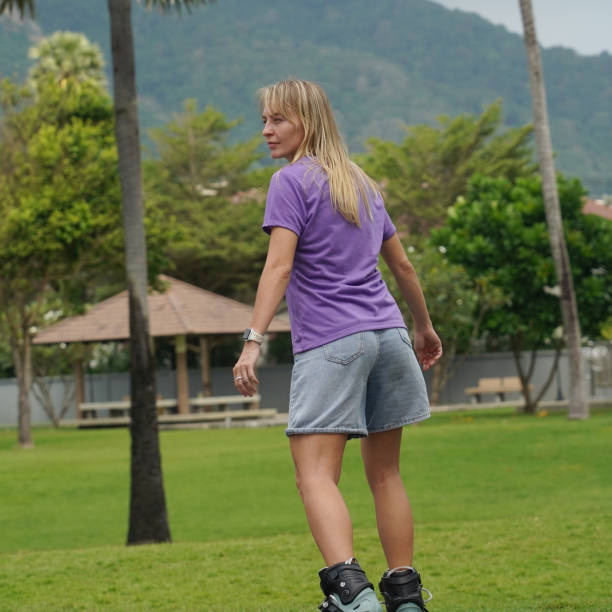
Many people start out on inline skates blazing along a straight line, but once they hit a curve, they become nervous—their bodies stiffen, their blades become unstable, their speed drops by half, and they even crash into a “human brake.” Do you envy those experts who can effortlessly carve corners and smoothly stick to the ground?
In reality, turning isn’t a matter of luck, nor is it simply a matter of “letting your body carry you through.” Truly smooth cornering comes from a mastery of three techniques: the inside edge, the outside edge, and the seemingly gimmicky crossover.
Master these, and you’ll find yourself skating not only more steadily and quickly but also with a more professional air.
1. What is edging? Understanding the Secrets of the Inner and Outer Edges
The term “edge” is common in ice skates. In the world of inline skates, even though we ride on wheels, the concept of “edge” exists.
Simply put, by tilting inline skates, one side of the wheel makes deeper and more stable contact with the ground, thereby controlling the direction or turning radius.
According to Wikipedia:
“Skaters can control turns or propel themselves by tilting their inline skates so that one side of the wheel creates more friction with the ground.”
This is called “edging.”
Inside edge: The side of the wheel closest to the centerline of your body. If you lean inward when turning, you are using the inside edge.
Outside edge: The side of the body that is away from the midline, usually used for support, stability, or control of direction at the end of a turn.
Many skaters just “feel the turn” when they first learn, but they don’t know which edge they are actually pressing. In fact, the switch between the inner and outer edges determines whether you can make a turn smoothly.
Excellent skaters can switch between the inside and outside edges naturally, drawing tracks on the ground like carving.
There is even a skater who said something very pertinent:
“To learn how to turn, first learn to control your inside edge, which is the engine of the entire movement.”
So don’t rush to “slide fast”; first understand the “blade.”
2. Technique 1: Inside Edge Turn / Carving
This is probably the first turn you’ll be introduced to, and it’s also the most natural. An inside turn is achieved by leaning your body slightly inward into the turn, allowing the inside wheel of your inline skates to press into the ground, creating an arc.
Key points of operation
- Weight inboard—Lean your body slightly, bring your knees inward, and press your inline skates inward.
- —aDon’t angle too hard – A common problem for beginners is over-pressing, which causes them to slide out of the turn. Keep it soft and don’t press too hard.
- —yourLead with your front foot, balance with your back foot – your front foot determines the direction, and your back foot controls your center of gravity.
- —youSwitch edge in the middle section – you can slightly cut to the outside edge in the latter part of the turn to help you exit the turn steadily.
Advantages and minor flaws
Natural, smooth, and well-controlled.
Can easily become unstable at high speeds or in wet conditions.
I recommend starting with wide corners, slowing down to get a feel for the friction of one side of the wheel against the ground. Once you’ve mastered it, move on to tighter corners.
You’ll understand the thrill of sliding through a corner with such ease that you’ll feel it flowing through your heart.
Tip 2: Outside Edge / Reverse Edge Control
The outside edge sounds like “sliding in reverse,” but it’s actually more of a balancer.
When you enter a corner with the inside edge and want to exit or stabilize the apex, you rely on the outside edge to support your body and prevent it from being thrown out by inertia.
Applications and Actions
- edge soCut the outside edge in the middle and back section—when exiting the turn, transfer the center of gravity from the inside edge to the outside edge, so that gravity and arc cancel each other out.
- ,In wide bends and low speeds – the outside edge can gently “drag” the body, preventing it from tilting too much.
- ,In the technique combination – sometimes you will even deliberately use the outside edge to correct the direction.
There is a very vivid suggestion in the sliding tutorial:
“Practice the inside edge, then transition to the middle edge, and finally the outside edge—that’s complete edge control.”
It sounds like a practice “from the heart out.”
Indeed, the outer edge appears more often in the “turning stability” stage than in the initial stage.
4. Technique 3: Crossover/Cross Step Turn
If the inside edge is the foundation and the outside edge is stability, then the crossover is the magic that makes you “fly” in the corners.
Its core
By stepping one foot over the other and using a “step-and-push” motion to complete a turn while maintaining or even increasing speed, many figure skaters and speed skaters consider it a required course.
Operation breakdown (taking right turn as an example)
- Entering the corner: Press the inside edge with your right foot first to guide the direction.
- Pull to the side and open the legs: Step the left foot over in front of the right foot, with the toes slightly facing inward.
- Shift your center of gravity: Shift your body weight to your left foot and push your right foot backward to generate momentum.
- Alternate: After pushing and stepping, switch back to the right foot, like a rhythmic dance step.
It may seem complex, but it’s actually a movement where “even your breathing has a rhythm.” By slightly twisting your upper body, bending your knees, and quickly switching your feet, you can maintain speed and line in the corners.
Advantages vs. Challenges
- The speed is not reduced but increased
- The curve is more beautiful
- Very enjoyable to watch (especially when shooting video)
- The rhythm is very demanding, and beginners may take too big a step or get stuck and lose balance.
Some skaters have shared their experiences:
“Don’t think about pulling with your inside foot; the key is to actively generate power with the leg that steps out.”
This sentence is very useful. You will understand it when you really practice it.

5. How to combine the three techniques?
In real skating, you don’t rely on just one move.
A complete turn is usually completed like this:
- Entering the curve: lightly press the inner edge to guide the direction;
- Mid-corner: add crossover and maintain speed;
- Turning: Use the outside edge to stabilize the body and adjust the direction.
- Low-speed small turn: just the inside edge and a small step.
Many skaters call this a “blended edge-footwork turn.”
When you can naturally switch between inside and outside edges and add a crossover into your rhythm, the smooth, clean, and slightly powerful turns are truly addictive.
6. Practice Suggestions and Notes
You need to practice the inside edge, outside edge, and cross step smoothly. Don’t be too fast. Slowing down will make you faster.
- Start by practicing slowly: if you practice too fast, your posture will become messy. Slow practice is more efficient.
- Breakthrough in stages: first master the inside edge, then the cross step, and finally practice edge switching.
- Left-right symmetry: Don’t just practice right turns; practice left turns as well, and keep your body balanced.
- Don’t skimp on protective equipment: knee pads, elbow pads, wrist guards, and a helmet—especially when doing push-ups.
- The ground should not be too slippery: if you practice blade-cutting on wet or gravelly ground, you will most likely fall.
- Use video recording: Record your body and footsteps to see if they are natural.
- Keep your knees soft: soft knees = high forgiveness.
You can draw a large arc route in the park and practice the inside edge slowly first; after you become proficient, add one or two cross steps, and when the whole curve is smooth and continuous, practice speed.

Conclusion: Blade and rhythm are the soul of sliding
The key to good skating isn’t the price of the shoes but the edge and rhythm.
When you can freely switch between inside and outside edges in a corner and add in a smooth crossover, it feels like the road is making way for you.
It’s okay to fall; every expert falls. The real difference is that they get up and try again.
With a few more laps, you too will go from being the “newbie who’s starting out on the curve and going the wrong way” to a true dancer on the curve.